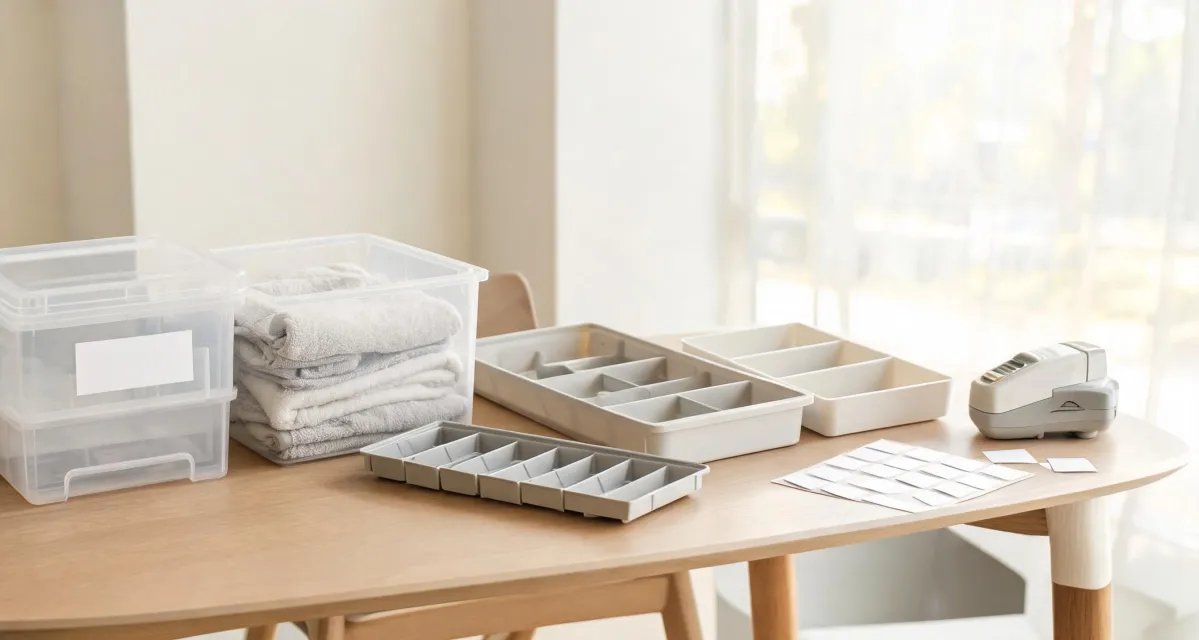
You are standing in front of a gap barely wider than your hand: the strip beside the bed frame, or the narrow slot in a dresser where folded shirts refuse to sit flat. One route climbs, turning a shoebox-sized footprint into several stacked levels. One spreads, covering the whole plane of the drawer so nothing ends up buried behind anything else. You cannot have both in the same slot, and the wrong pick is the one you notice every morning.
Two Ways to Fill the Same Narrow Gap
Each route buys a different kind of room. A vertical tower buys elevation: every added level is a new surface while the footprint stays small. A wide shallow insert buys reach: it spends the whole plane of the drawer or shelf, and everything stays in plain sight. mdesign's public product pages describe this same layer in furniture terms, a washable 100% cotton liner, a solid wood frame, and assembly that needs no screws or tools. Those are maintenance and adjustment properties rather than capacity numbers, which points at when a narrow-space organizer is really judged: on the day you clean it or rebuild it for a different gap.
Both routes are sold on the same promise, more storage in less space, so the comparison has to be written in units the shelf enforces. Vertical storage buys levels; wide shallow storage buys sightlines and one-gesture access. What actually settles the choice between the two is measurable long before anything is bought, and none of those measurements is a capacity figure you have to trust on the box. The gap sets the limits, and the section that follows reads those limits off one at a time, in the order your hands meet them.
What 'Narrow Vertical' Actually Measures
How narrow does a gap have to be before vertical stacking is the reasonable answer? Narrowness is not a width, it is a relationship among three numbers you can measure in a minute. Depth clearance comes first, and safety guidance for storage containers frames the same question from the content side: the gap must be deeper than the container body plus the grip space your fingers need at the front edge, or the front layer is the only usable one. Pull-out and door swing come second: a door that stops partway caps how far any insert travels, and a tall stack inside a short travel zone turns storage into scooping. Net height, measured after shelf lips and overhangs, comes third.
Capacity figures rank last because they are the one measurement a shelf cannot contradict once the first three are settled. A unit advertising many compartments still fails if the gap is slightly shallower than its usable depth, and a stack that fits perfectly still fails if you must lift two layers to reach a daily item. Choosing a shape before measuring is how returns happen: the shape gets locked in first, and the opening gets blamed for it.
Side by Side: Three Vertical Storage Moves
Line the three moves up against the same three columns and the choice stops being about shape. Height fit leads: a vertical tower needs the full net height of the opening and gains a level every few inches, stacked drawer boxes need only as much height as the boxes you commit to, and a wide shallow insert barely uses height at all. Access cost follows: the tower buries frequent items behind a front layer, drawer boxes give each category its own pull, and the shallow insert keeps everything in one gesture. Maintenance closes the comparison, and reviewers apply sealed, durable, easy-to-clean construction as the filter for the whole category, which is why an unwashable liner matters more than an extra slot.
Each move has conditions under which it is the better call, and none of them is right everywhere. A vertical tower earns its keep when the opening is tall, the depth generous and the contents mostly low-frequency: spare linens, off-season clothing, archived paper. Stacked drawer boxes suit awkward middle heights, where a tower cannot gain a second full level but two boxes rest comfortably. A wide shallow insert wins when items are touched daily and the plane is deep enough for fingers to reach the back without lifting anything. Large-scale container testing reaches the same ordering principle from another category: durability and easy cleaning separate the keepers from the rest, and a seal counts only if it survives repeated handling.
The Trade-off Engineers Notice First: Access vs Density
Density is easy to sell because it is one number: how many items fit inside the footprint. Access cost is hard to see because it is paid in seconds, dozens of times, for as long as you own the thing. Two extra levels in a hand-wide gap is roughly a third more items on the same floor area, but reaching anything on the back half of a level means lifting the front half out, retrieving what you came for, and putting it back. Brand-side details point at the same recurring cost: washable liners, finishes that resist dirt and bases that let air through exist because stored goods get handled, soiled and cleaned again.
The counterexample is easy to picture. You have a gap the height of three stacked boxes, so you build the tower: seasonal items on top, spares in the middle, daily items at the bottom. The top box becomes a lid nobody opens, the middle holds things you have forgotten, and the bottom, the only layer reachable without moving anything, is overloaded past its dividers. Nothing broke and nothing was mislabeled: the stack pushed its access cost onto the layer you use most, and that layer had no slack left.
Where Materials Change the Math
Materials become the deciding variable only under a specific rhythm of use. If the contents of your narrow gap are static, archived files or off-season bedding, a washable liner and a solid frame are pleasant but rarely decisive. Change the contents to gym clothes, kids' socks or craft supplies and the math shifts: the liner has to survive washing, the frame has to hold its shape after being partly disassembled, and the whole unit has to tolerate being emptied and reloaded. mdesign's public material describes exactly that layer, washable 100% cotton, a solid wood frame, a dirt-repellent finish and a ventilated base, a maintenance claim rather than a capacity claim. On a high-turnover gap, that claim outweighs an extra level.
Tool-free assembly and biodegradable materials matter for the same reason, and they matter most to someone who has already reorganized the same gap twice. A unit that goes together without screws can be taken apart and restacked when contents change category or when the organizer moves to another room, with no missing hardware, no stripped holes and no replacement purchase. Biodegradable construction is the end-of-life version of that idea: the object can be adjusted and eventually disposed of without leaving a permanent problem behind. As a comparison column, both favor whatever is easiest to change later, even when it holds slightly less on day one.
The Rule: When to Stack Up Instead of Spreading Out
A narrow vertical organizer wins in a specific, checkable situation: the opening is deep enough for the full body plus grip space, the door or drawer travels far enough that the front layer stays reachable, the net height allows at least two levels with clearance, and most of what goes in is touched rarely. Under those four conditions, stacking upward uses the slot better, and the tower turns dead space into real capacity. Step outside any one of them and the advantage reverses: a short, deep, high-traffic gap favors the wide shallow insert, because reach beats levels there. That is also where the brand-side maintenance claims (washable cotton, wood frames, screw-free assembly) enter the verdict: they show which option survives being reorganized, rather than how much it holds.
Here is the rule, in three steps. First, measure the gap: usable depth minus the container depth, how far the door or drawer actually opens, and net height after obstructions. Second, sort the contents into two piles by how often you touch them, daily and occasionally, and note which pile is larger. Third, choose shape last: if the opening is tall, deep and mostly low-frequency, go vertical; if it is short, spread across the plane and keep the daily pile within one reach; if the height sits between, stack modular boxes and stop at the level where reaching stops being a single gesture.
Keep the rule where you measure: depth and travel first, then frequency, then shape. The gap in your home is not deciding between a taller stack and a wider tray; it is deciding how many times a week you are willing to lift one thing to reach another. Once that number is on paper, a vertical organizer either earns its levels or it does not.

Leave a Reply