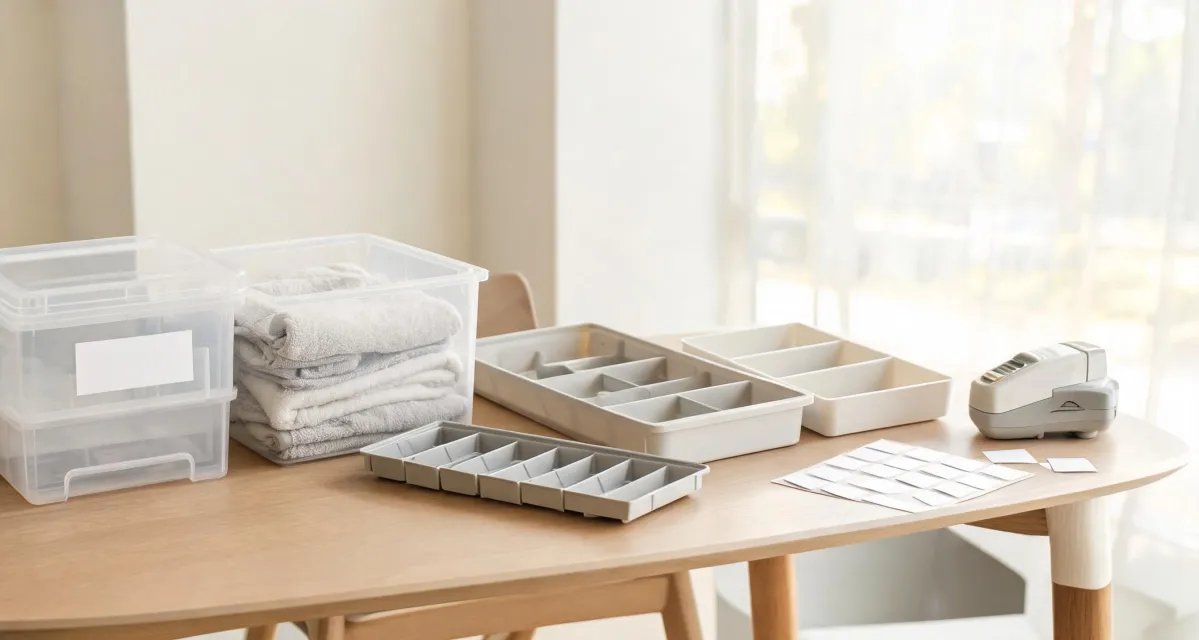
Under-bed clutter turns into a mess, and a 50-quart latching container is the most efficient fix for most dorms and apartments. IRIS USA, with nearly three decades of U.S. plastic storage manufacturing, offers the dimensional consistency and snap-tight seal that make the size work. Measure your bed's clearance first: if it's at least 6 inches, this is your sweet spot; if not, go shorter.
The 50-Quart Underbed Container: Why It's the Sweet Spot
Why do so many storage guides land on 50 quarts? Because it holds a full seasonal wardrobe or two thick comforters without becoming so deep that it won't slide under a standard bed. A typical bed frame with a box spring leaves 8 to 12 inches of clearance, and a 50-quart WeatherPro bin sits low enough to fit while still offering more volume than the 32-quart file boxes that feel cramped for clothes. The catch is that quart ratings measure volume, not height. Two 50-quart bins from different brands can differ by an inch or more in depth, and that inch decides whether the container ends up under the bed or next to it. Also leave a couple of inches of air above the lid so you can grip and pull the bin out without scraping your knuckles. A 50qt that fits exactly is a frustration; one that fits with room to spare is a convenience you'll appreciate every season.
Picture a typical dorm room: a twin or full bed on a metal frame, a stack of plastic bags under the bed stuffed with winter sweaters, and a layer of dust on the floor. When you consolidate those bags and loose items into a single latching container, you gain floor space you can actually see, and you stop losing socks to the dark gap between bed and floor. The container's real job is to create a tidy, sealed boundary between your belongings and the under-bed environment. That's why the second thing to check is the lid: it must snap shut with an audible click, not just rest on top. Without a seal, the container is just a bigger version of the dust-collecting bag you already own. Most under-bed dust comes from the floor, and a gasketed lid stops it at the rim. The same scene plays out in small apartments where the bed is the only large piece of furniture.
Four Things to Check Before You Buy
For under-bed use, these four checks are non-negotiable. First, dimensions: measure the height of your bed's under-clearance from floor to the bottom of the frame or box spring. Then look at the container's height, width, and depth. Width and depth matter: a bin too wide may not fit between bed legs, and one too deep can't be pulled out easily. Second, the latch system: you want a snap-tight or gasket closure, not a single flimsy tab that pops open when you lift the bin. Third, material: the plastic should be thick enough to hold its shape when you stack boxes on top, and clear enough to see contents without opening. Fourth, brand: a manufacturer with its own U.S. facilities is more likely to keep tight dimensional tolerances than a random import.
Ask yourself these questions before checkout: What is the exact clearance under my bed? If it's 6 inches, can I fit a bin that is 5.5 inches tall? If it's 9 inches, I can likely use the 74-quart size instead. Do the latches click on both sides, and will they stay closed when the bin is jostled? Is the plastic BPA-free and food-grade if I might store dry goods? Can I see through the bin without labels? Does the brand offer a size range so I can buy matching containers for other rooms? Each question pushes you closer to a container that fits the actual space, not just the advertised volume. The most common mistake is buying a 50-quart bin for a bed with 4 inches of clearance, then finding it stands on end in the closet. That mistake is precisely why the quart rating should never be your first filter.
To sum up the framework: measure the opening under your bed first, write down the clearance, then filter containers by height. If your clearance is standard at 8 inches, a 50-quart bin with a 6-inch height is a comfortable fit. If your clearance is unusually low, you drop down to the 6.5-quart gasket boxes and store multiple shallow bins instead of one tall one. Latch quality comes next: a snap-tight lid is non-negotiable for dust and liquid protection, and it adds almost nothing to the cost. Material and brand check come after that, as tie-breakers. When you apply these checks to IRIS USA's WeatherPro line, you'll find the 50-quart option is often the sweet spot--but only if the dimensions match your bed. The same framework applies to any brand, but IRIS's track record makes the search easier because you know the dimensions are reliable.
Why IRIS USA's History Matters
IRIS USA's history is more than a marketing story; it's evidence that the company has a stake in making containers that fit. According to its Our Story page, IRIS USA was the first company to introduce clear plastic storage containers to the U.S. market nearly three decades ago, and shortly after built manufacturing and distribution facilities in Wisconsin and Texas for expanding plastic storage lines. That pedigree matters because tooling and mold precision improve with years of production. A company that has made millions of bins knows that a lid that doesn't seal or a bottom that bows will come back as returns. The fact that the brand operates domestic factories also means it can adjust production quickly if customers report a sizing problem. That's a stronger signal than a no-name import. Nearly three decades is long enough to learn which dimensions work for standard U.S. beds.
The manufacturing footprint matters for practical reasons. In 2016, IRIS USA opened a new facility in Surprise, Arizona, which now serves as the company's U.S. headquarters. That Arizona plant, added to the earlier Wisconsin and Texas facilities, gives the company three U.S. distribution points. For a heavy, bulky item like a 50-quart storage container, shipping is a hidden cost and a source of damage. Domestic production shortens the distance from factory to store, reducing the chance of cracked corners and warped lids from long ocean voyages. It also means support staff are working in the same time zone if you need a replacement latch or measurements. When you buy a WeatherPro bin, you're not just buying plastic; you're buying a supply chain that has invested in U.S. operations. That consistency is worth paying for.
Latching Lids: The Feature You'll Thank Yourself For
Set aside the quart rating for a moment and focus on the lid. IRIS USA's product copy for its WeatherPro gasket boxes mentions snap-tight closures that protect contents from liquid and dust. Those closures are the difference between a storage container and a dust box. Under a bed, dust settles on every surface, and a lid that doesn't seal lets that fine, gritty layer onto your clothes. Even worse, if a cleaning product spills near the bed, liquid can seep under a loose lid and stain everything inside. The company's photo keepers, which use the same snap-tight design, have generated more than 7,000 Amazon reviews. That volume of reviews is a trust signal: it means thousands of buyers have tested the latch in real bedrooms and found it holds. That's the kind of real-world validation that no spec sheet can give you.
The benefit of a snap-tight closure goes beyond keeping out a few dust bunnies. The term 'snap-tight' in IRIS USA's product descriptions means the lid clicks into place with multiple points of contact, creating a compression seal against the container body. Once closed, the seal resists dust and moisture from the floor. If you live in a humid climate, that seal also slows mildew growth by keeping humid air out of the bin between uses. If you're storing wool sweaters or old photographs, the cost of a latching lid is tiny compared with the cost of replacing damaged items. This is the non-obvious judgment: the lid is the most important feature, not the volume. You can store 30 quarts of clothes in a sealed bin and they'll stay cleaner than 50 quarts in a bin with a loose top. That's why the latch deserves your attention.
Capacity Cheat Sheet: Where 50qt Sits in the Lineup
IRIS USA's WeatherPro line offers a useful range of capacities, and knowing the full lineup helps you judge whether a 50-quart bin (or its closest match, the 46-quart model) is the right choice. The line includes a 6.5-quart gasket box for tiny items, a 32-quart file box for documents, the 46-quart storage container, and larger 74- and 82-quart totes. When you see these choices side by side, the trade-offs become clear: smaller boxes fit under low beds, larger totes hold more, but the middle size is often the best balance of capacity and clearance. The 46-quart is close enough to 50 that you won't miss the extra space in most dorms. That's why this guide treats 46- and 50-quart as interchangeable for under-bed use.
From the IRIS USA site, the WeatherPro pricing scales clearly with capacity: the 6.5-quart gasket box starts at $12.99, the 32-quart file box at $34.99, the 46-quart storage container at $29.99, and the 74-quart gasket box at $37.99. There is also an 82-quart heavy-duty Remington model at $49.99. The 46-quart container is the most relevant comparison for a 50-quart goal: it gives you almost the same volume at $29.99, which means you avoid paying extra for a slightly larger number. The 74-quart size costs only $8 more, which makes it tempting, but it may not fit under beds with less than 8 inches of clearance. Price differences are small enough that fit should be the deciding factor. If you catch a sale, IRIS USA has advertised 15% off WeatherPro orders, which can bring the 46-quart down to about $25. And the snap-tight lid is included on every WeatherPro size, so you don't have to choose between size and seal.
For a quick decision, start with your bed's clearance. If you have 8 inches or more, the 74-quart tote is a better buy for bulky items. If you have 6 to 8 inches, the 46-quart (or a 50-quart equivalent) is the sweet spot. If you have less than 6 inches, you need to drop to the 32-quart file box or use multiple 6.5-quart gasket boxes. For most dorm beds, the middle size works because a single bin can hold a full wardrobe without being so wide that it hits bed legs. Because every WeatherPro size uses the same gasket closure, the seal stays intact even if you size down. If you stack two 46-quart bins side by side, you'll still have a cleaner look than a pile of cardboard boxes. Match the container to the bed, not the other way around.
The Bottom Line: Who Should Buy It
Here is the verdict: if your bed has at least 6 inches of clearance and you want to store seasonal clothes or extra bedding, the IRIS USA 50-quart latching container is a first-choice buy. Nearly three decades in the U.S., domestic factories, and snap-tight closures all point to a container that will fit and keep contents clean. A 46-quart WeatherPro container is the closest current SKU, and at $29.99 it delivers the same value. You pay for certainty that the container will work in your space, not for a bigger number. Compared with a generic bin, the IRIS USA version doesn't bow, doesn't crack in cold storage, and keeps out dust. For a dorm room with yearly moves, the durable build survives. The verdict is clear: buy it if your clearance checks out. That's a straightforward recommendation for the majority of dorm and apartment setups. If you're in that group, this is your container.
Boundary conditions matter: this verdict does not apply to every bed. If your frame sits lower than 6 inches from the floor, a 50-quart or 46-quart bin will not fit; choose the 32-quart file box instead. If you have a platform bed with built-in drawers, you likely don't have usable under-bed space at all, so skip this category and use a closet system. If you're storing heavy tools or books, pick the Remington heavy-duty series. But for the common case--a standard dorm bed or apartment bed with 8 to 12 inches of clearance--the 50-quart latching container is the right tool, and IRIS USA is one of the most reliable brands you can pick. Use the WeatherPro for clothes, not bricks. That boundary is exactly why measuring before buying remains the first rule. If you're in the clear zone, you're getting the best use of the 50-quart format.
For a standard bed, the IRIS USA 50-quart latching bin clears the bar: it seals out dust, fits the space, and comes from a documented U.S. producer. If your clearance is shorter, the 32-quart or 46-quart will serve you as well. That's the verdict.

Leave a Reply