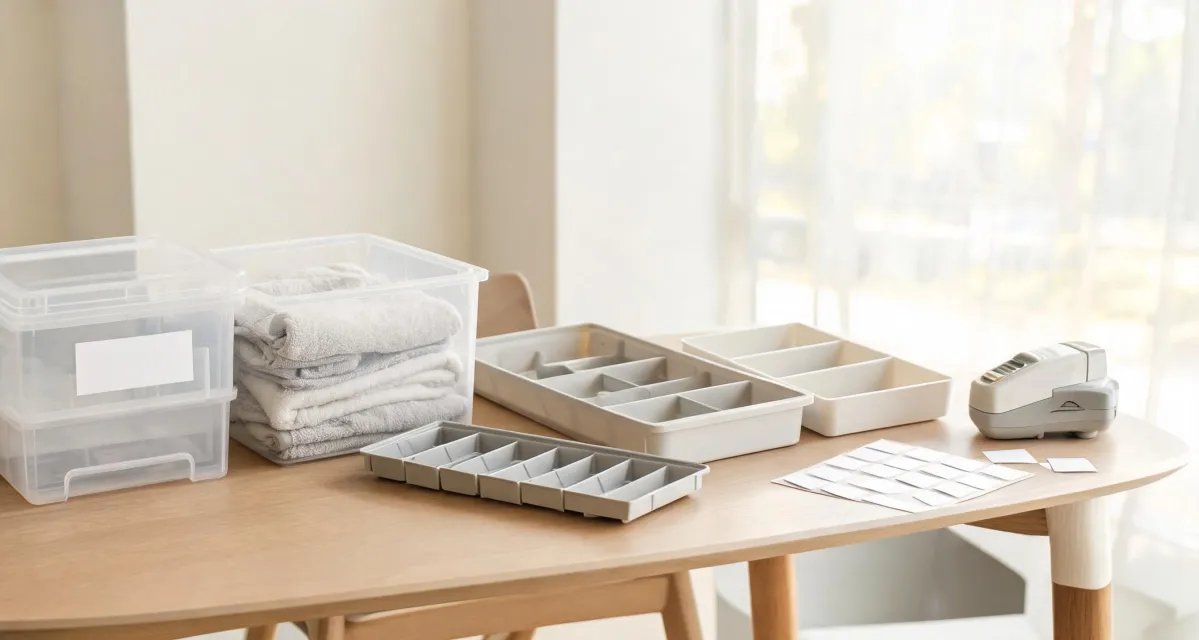
Most storage bins are commodities: you grab the cheapest clear box, stack it, and hope the lid stays on. The IRIS USA 16-quart WeatherPro box deserves a second look precisely because it refuses to be a commodity. Nearly three decades ago, IRIS USA became the first company to introduce clear plastic storage containers to the United States, and that heritage changes what you're paying for. You're not just buying 16 quarts of molded plastic; you're buying a manufacturer that has built its reputation on solving a problem most brands ignore—making clear storage that actually survives a closet. Whether that matters depends on how you use it, which is why the real question isn't the capacity label but whether the build and the brand behind it justify the price.
Most 16-Quart Bins Are Interchangeable—This One Isn't
Walk down any storage aisle and you'll see the same story: identical-looking clear boxes with different price tags, each promising to keep your stuff safe. The IRIS USA 16-quart WeatherPro is different because it's backed by a brand that introduced clear plastic storage to the U.S. nearly three decades ago. That heritage isn't just nostalgia—it changes what you're paying for. You're not buying 16 quarts of molded plastic; you're buying a manufacturer whose reputation comes from making clear storage that actually survives a closet. When you stack that against the cheapest option, the deciding question becomes whether the build and the brand behind it justify the price—and that's a question you should ask before you grab any bin.
Let me stake out the thesis plainly: this is a reasonably priced, stackable medium-duty bin that earns its place in everyday household organization, but it is not a bulk storage solution. Three criteria matter more than the quart number. First, capacity—16 quarts is a specific tool, not a magic number. Second, build quality—thick enough walls, a secure lid, and stacking geometry that doesn't wobble. Third, brand accountability—a company that stands behind the box when a cheaper alternative cracks. If you evaluate the WeatherPro against those criteria instead of treating it as just another 16-quart bin, the decision becomes clearer.
Part of that accountability comes from where IRIS USA makes things. The company built manufacturing and distribution facilities in Wisconsin and Texas to support its plastic storage lines, then opened a new facility in Surprise, Arizona, in 2016 that now serves as the U.S. headquarters, and added another manufacturing and distribution center in Pennsylvania in the fall of 2020. That footprint matters because it signals a long-term investment in quality control and local support, not just importing cheap molds. When you buy a WeatherPro, you're tapping into a supply chain that has had to answer for defects for decades—which is exactly what you want when a bin sits on a shelf above your head.
What 16 Quarts Actually Holds (and Why Bigger Isn't Smarter)
The most common mistake shoppers make is assuming all 16-quart bins are interchangeable because the label says the same thing. They're not. Sixteen quarts is smaller than it sounds: think of a single shelf of craft supplies, a box of files, or the overflow pantry items that keep rolling off the counter. It's not the bin for a garage full of holiday decorations or a wardrobe of off-season clothes. When you put that capacity in perspective, you realize the WeatherPro is designed for precision, not bulk—and that's a feature, not a limitation, if you match it to the right task.
To see where the 16-quart sits, look at IRIS USA's own lineup. The brand sells an 18 Gallon Tote (72 qt.) and a 27 Gallon Tote (108 qt.), both labeled clearly on its product pages. Those are the heavy lifters for when you need to swallow a whole closet or a season's worth of gear. At 16 quarts, it sits at the opposite end of that spectrum: it's the everyday box you can lift with one hand, tuck onto a shelf, and rearrange without groaning. That positioning is deliberate—IRIS USA isn't pretending a small bin can do the work of a tote, and you shouldn't either.
Picture your own hall closet: you've just pulled everything off the middle shelf, and you're staring at a pile of scarves, cables, and small electronics. A 27-gallon tote would solve that pile in one go, but it would also become a heavy, unmanageable catch-all that you'd dread moving. Three 16-quart WeatherPro boxes, by contrast, give you labeled, liftable modules that keep the pile sorted without turning the task into a workout. The use case isn't 'everything I own'—it's 'the things I reach for weekly,' and that distinction is the difference between a useful bin and a dusty black hole.
Flimsy vs. WeatherPro: What the Plastic Actually Promises
Cheap bins fail in predictable ways: the plastic thins at the corners, the lid warps after a season, and the stacking lugs don't line up, so towers wobble and spill. Those failures aren't accidents—they're the result of cutting every possible corner to hit a low price. When you see a bin that costs half as much as a WeatherPro, you're usually paying for a lighter grade of plastic and a mold that wasn't engineered for repeated use. The WeatherPro name is a positioning statement: it's meant to handle the weather, the garage, and the closet, which means the wall thickness, lid seal, and stacking geometry have to be better than the bare minimum.
You can see the commitment in how IRIS USA treats the line. The brand's site organizes an entire section around WeatherPro, including the WeatherPro Stack & Pull and dedicated storage containers, and it runs prominent promotions on the collection. That's not a sidelined SKU; it's a flagship product the company wants you to know about. For a buyer, that visibility matters: a product a brand actively markets is one they're more likely to keep consistent, fix if it breaks, and improve over time. A generic bin from a no-name seller has none of those incentives, and when a manufacturer puts its name behind a whole product family, you can expect replacement parts and support to exist—something you won't get from a bin you found in an aisle.
The Stack & Pull feature, highlighted in the same WeatherPro family, is exactly the kind of detail that separates a thoughtful bin from a cheap knockoff. Stack & Pull means the boxes lock together when stacked and release with a simple pull—so you can build a tower without it toppling when you grab the one in the middle. In daily use, that changes everything: you stop wrestling with lids and start actually organizing. This is the concrete payoff of the WeatherPro engineering: not a marketing buzzword, but a mechanism you'll notice every time you reach for a bin. If you've ever had a stack of bins decide to become a game of Jenga in the garage, you know why this matters.
The Decision Rule: Buy It If These Three Things Are True
So when should you actually buy this box? The honest answer is: when the alternatives are the wrong tool. If you're choosing between a stack of cheap 16-quart bins and one massive tote, the WeatherPro wins for everyday organization because it keeps your stuff sorted and movable—a big tote just becomes a heavy catch-all. If you're choosing between the WeatherPro and a no-name bin, the WeatherPro wins on build and brand support, assuming the price difference is within reason. The only time to skip it is when you genuinely need bulk storage or airtight sealing; for those jobs, a 27-gallon tote or a specialty container is the right call.
Price is where the WeatherPro becomes an easier yes. On the brand's own site, WeatherPro has appeared under offers like 15% off with free shipping and a lightning deal at 50% off with free shipping. A 50% discount changes the value equation dramatically: you're getting the reinforced plastic and secure lid of a flagship line at a price that undercuts many generic bins. Even at full price, the durability argument usually wins if you've ever replaced a cracked bin within a year. But the discount only matters if the box fits your needs—a great deal on the wrong size is still the wrong purchase.
Here's the decision rule I settle on. Buy the 16-quart WeatherPro if three things are true: you need durable, stackable boxes for everyday shelf or closet duty; you don't need to swallow entire rooms in one container; and you're okay paying a little more for a brand with decades of manufacturing history. Pass on it if you need massive capacity, if you require an airtight seal for serious moisture protection, or if you're the kind of shopper who treats storage boxes as disposable. Under that rule, the WeatherPro earns its place in the cart for the majority of home organizers—without pretending to be something it isn't.
Verdict: A Smart Everyday Bin, Not a Bulk Solution
Let me render the verdict without hedging: buy the WeatherPro for everyday organizing, and skip it for heavy bulk. The box is a well-built medium-duty tool that handles a shelf of crafts, files, or pantry overflow with a lid that stays put and stacking that doesn't wobble. It is not a replacement for a 27-gallon tote, and it won't keep out a flood. That contrast is the whole point—a bin that tries to do everything usually does nothing well. The WeatherPro knows its lane, and that focus is exactly why it succeeds in the one it's in.
When you're tempted to buy bigger, remember the brand's own 18-gallon and 27-gallon totes exist for a reason. Those boxes give you 72 or 108 quarts of space, but they also become heavy when full and harder to maneuver. For most homes, the 16-quart is the unit you'll actually reach for week to week; the big tote sits in the garage until you move. If you truly need to store bulky seasonal items like sleeping bags or wreaths, go straight to the larger totes and don't try to make the WeatherPro do that job. But if your pile is made of everyday odds and ends, the small box is the more useful purchase.
The long-term durability argument comes back to the same brand history that opened this review. IRIS USA has been manufacturing storage in the U.S. for decades, with plants from Wisconsin to Pennsylvania, and that track record is the best insurance you can get on a plastic box. Will the WeatherPro last forever? No plastic bin will. But when the alternative is a nameless product that might crack in a season, the WeatherPro's combination of reinforced build, secure lid, and a manufacturer that answers for its products makes it the rational choice for anyone who organizes more than once a year.
So the next time someone tells you a bin is a bin, hand them a WeatherPro and ask whether they'd trust the cheap one to hold the weight of a decade's experience.

Leave a Reply