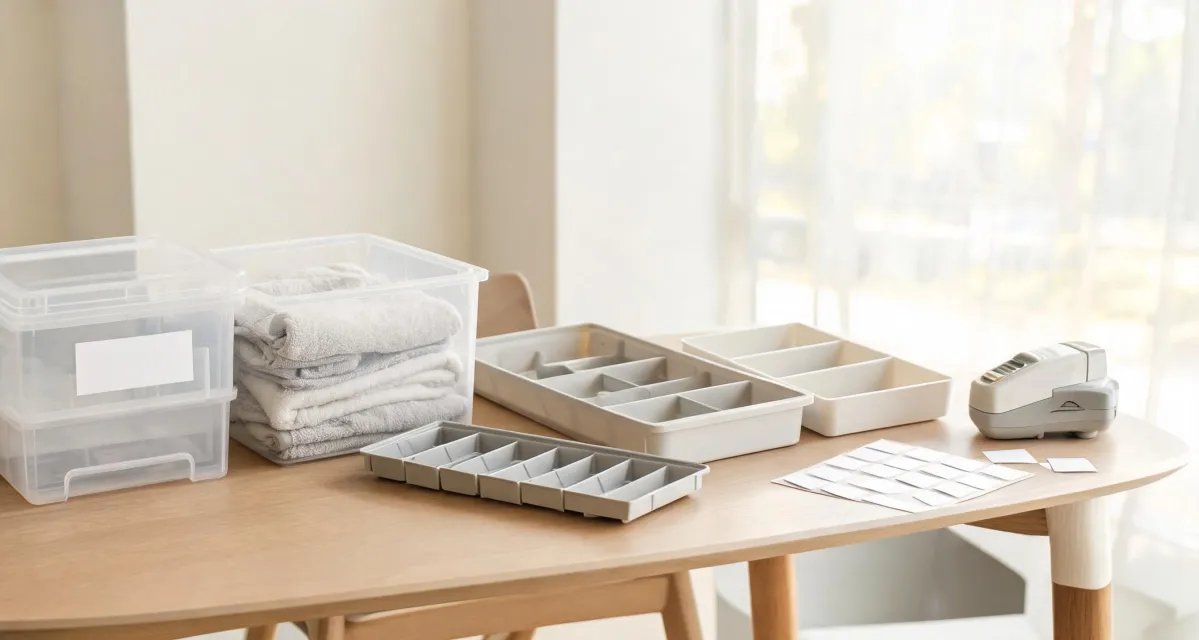
Should you swap your cardboard tower for a stack of drawers? If you’re juggling off-season clothes, toys, and tools, the answer isn’t about looks—it’s about how often you want to unstack to reach the bottom. Cardboard boxes are cheap, but they make you lift everything above. Drawers change that: pull the front panel, and the item is there, even at the bottom of three levels. The IRIS USA 30 qt. stackable storage drawer (2-pack) is built for this access advantage, and its 2-pack price can make paired purchase more economical—if you truly need two. But before you order, weigh four dimensions: real capacity, stacking stability, resin quality, and unit price. This article evaluates each with an engineer’s logic, separating durable design from marketing.
Stackable Drawers vs. Cardboard Boxes: Which Mess Wins?
Are you still stacking cardboard boxes, or should you switch to drawers? If you are juggling off-season clothes, toys, and tools in your bedroom, garage, or playroom, that question is not about aesthetics—it is about how many times you are willing to unstack everything to reach what you need. Cardboard boxes are cheap, but every retrieval means lifting the ones above. A drawer system changes the mechanics: you pull the front panel, and the item you want is right there, even if it sits at the bottom of a three-level stack. The IRIS USA 30 qt. stackable storage drawer (2-pack) is built around that advantage, and it also claims better stack stability because you never unbalance the column when you reach in. But before you order, you need four comparison dimensions: how much 30 qt. actually holds, how the stacking mechanism performs, whether the resin quality justifies the brand premium, and how the 2-pack unit price compares with buying singles. This article evaluates each one with an engineer's logic, so you can separate real durability from marketing.
The choice between bins and drawers becomes clearer once you see how a manufacturer like IRIS USA frames the category. On its official product pages, the company lists Stackable Storage Drawers alongside WeatherPro File Boxes, Under Bed Storage, and Eco-Friendly Office File Storage. That product-line breadth matters because it signals that drawer systems are not an afterthought—they are a core category with dedicated tooling. When you compare, you are not choosing between a random bin and a random drawer; you are comparing two engineering approaches from a brand that builds both. The presence of multiple storage alternatives also means you should weigh trade-offs honestly: boxes maximize volume per dollar, while drawers sacrifice a little interior space for access. The decision framework, then, rests on how you retrieve items, not just how much you can stuff in.
30 Qt. in Real Life: What It Holds
What does 30 qt. actually hold? Picture a stackable drawer that is roughly 30 inches wide, 17 inches deep, and 9 inches high—about the size of a large suitcase. In that volume, you can fit six to eight folded sweaters, or a full set of king-size sheets and pillowcases, or two dozen toy cars with room for a board game on top. When IRIS USA lists its storage lineup, the company places stackable drawers in the same ecosystem as seasonal totes and shelf units, which tells you the intended use is medium-density household items, not heavy tools. For a garage, one 30 qt. drawer holds a full socket set plus a cordless drill with batteries; for a bedroom, it cycles off-season clothes without creating a leaning tower. The key is that 30 qt. is enough for a meaningful category, yet small enough to keep the drawer pull-out light. If you try to store books or canned goods, you will hit the weight limit fast.
Put the capacity to work in a real scenario. In a bedroom, stack two of these drawers on a sturdy dresser or on the floor: the bottom one for off-season turtlenecks, the top one for workout gear. You can slide the top drawer out without moving the bottom, which is the entire point. In a playroom, fill one drawer with building blocks and the other with art supplies; children can pull their chosen drawer to the floor, and the stack stays put because the weight is applied to the rail, not the side panels. In a garage, one drawer for hand tools, one for car-cleaning supplies. The 30 qt. size suits items you want to categorize, not massive bulk. If you find yourself tetris-ing large items into it, you have chosen the wrong capacity; step up to a tote for that. The drawer's real job is to make medium items accessible and visible, and the two-pack gives you two classification zones without mixing.
Stacking Stability: Why Drawers Beat Boxes
Will a stack of drawers topple the first time you pull the bottom one? That is the worry most people carry from box-on-box storage, where rummaging through the bottom bin means shifting the entire column. A well-designed drawer stack answers with a different load path: the drawer slides on rails, and the housing carries the weight of the boxes above. When you pull a drawer out, the center of gravity shifts forward, but interlocking grooves and a wide footprint keep the column from pitching over—provided the stack is on a level, hard floor. IRIS USA's product catalog includes stackable storage drawers as a dedicated line, which means the interlock geometry is engineered for repeat stacking, not a one-off bin. The practical rule: keep the heaviest drawer at the bottom, do not stack more than three or four high, and load evenly. With those conditions, drawer-style stacking is genuinely more stable than a tower of boxes you have to unbalance to access.
Here is the mechanism in plain terms. A box stack is stable only while everything is static; the moment you lift the top box, you create a temporary cantilever. Drawer stacks avoid that because you never lift the boxes above—you slide the drawer out from the side. The rails transfer the pull force to the side walls of the housing, and because the drawers interlock with the units below, the whole column acts like a single rigid frame. The trade-off is that you need some floor space in front of the stack to open a drawer, and you should avoid loading the top drawer with items that exceed the unit's weight rating. If you keep the stack against a wall and on a level surface, the design is mechanically sound. That is why drawer organizers have replaced box towers in many workshops and closets: they prioritize retrieval without sacrificing stability. For the IRIS USA 30 qt. unit, the engineering focus is on that rail-and-interlock system, which is what separates a drawer from a bin with a flap.
Resin Quality and Brand Trust: The Evidence Behind Durability
Plastic drawers feel flimsy? Yes, many cheap units do. The tell is not the thickness of the side wall alone—it is the way the drawer bottom attaches, how the rails guide movement, and whether the unit has reinforcing ribs. Before you judge IRIS USA, you need a reality check: the company operates manufacturing and distribution facilities in Wisconsin, Texas, Arizona, and Pennsylvania, which is a very different supply story from a white-label importer. That footprint means the tooling for stackable drawers is in-house, and quality control happens onshore. The plastic itself is typically polypropylene, a material that resists cracking and handles temperature swings. But even good resin fails if the design is poor. Look for drawers that have a solid base, smooth-sliding rails, and a locking tab between units. The material doubt usually evaporates when you put the unit together and feel the fit.
Look at the evidence behind IRIS USA's durability claims. The company's own history notes that manufacturing and distribution facilities were built in Wisconsin and Texas to support expanding plastic storage lines. In 2016, it opened a facility in Surprise, Arizona, which now serves as the U.S. headquarters; in the fall of 2020, it added another manufacturing and distribution center in Pennsylvania. That is a multi-state production base, not a warehouse for imported goods. On the product side, a related IRIS USA storage item—the WeatherPro 6.5 QT Gasket Box—lists for $12.99 and has attracted more than 7,000 Amazon reviewers. A seven-thousand-review sample is a meaningful reliability signal because it means thousands of independent users have stress-tested the resin and hinges over time. The same brand discipline that supports that launch also supports the stackable drawer line. So when you worry about plastic cracking, you are not betting on an unknown; you are betting on a manufacturer with sustained U.S. investment.
2-Pack Pricing: How to Calculate True Value
Does the 2-pack actually save money? The answer is usually yes, but only if you need two drawers. To evaluate true value, you must compare the 2-pack's total price against the price of two individual drawers, and then divide by two to get the per-drawer cost. A 2-pack that costs, say, $39.99 works out to $20.00 per drawer; if a single sells for $23.99, you save $8.00. IRIS USA's own site provides useful anchors for this calculation: a storage container is listed at $29.99, and a 6.5 QT WeatherPro gasket box starts from $12.99. Those numbers show the brand's spread across sizes, and they imply that a mid-size 30 qt. drawer will sit somewhere in that range. The 2-pack price, when it appears, almost always undercuts the equivalent two singles because the manufacturer saves on packaging and shipping. The catch: if you only need one drawer, a 2-pack is not a deal—it is an expensive extra that takes up space. The true value equation is per-drawer cost, not total price.
Let's make the verdict concrete. Calculate true value in three steps. First, confirm you have two distinct storage zones that need a drawer—two closets, two kids, two categories. Second, check the 2-pack's total price and the single-unit price at the same retailer; divide the 2-pack by two and compare. Third, add the hidden costs: shipping, assembly time, and floor space. If the per-drawer cost of the 2-pack is within 10% of a single, the 2-pack is usually the better buy because you get matching units that stack cleanly. If the price gap is small and you are not sure about the second drawer, buy one single first and test the size. Remember that a 2-pack is a commitment to the system; if you later decide drawers are not for you, you double the mistake. So the value verdict is conditional: the 2-pack wins on economics and stack consistency when two drawers are genuinely needed; it loses when you are buying for the number.
The Verdict: Who Should Buy the IRIS USA 30 Qt. 2-Pack
Who should actually buy this product? Let's look at the context. IRIS USA's catalog spans everything from WeatherPro boxes to WOOZOO air circulators, which means the company is not a one-trick pony; it has a broad storage ecosystem. Within that ecosystem, the 30 qt. stackable drawer targets a specific buyer: someone who has medium-sized items that need category separation and frequent access. If you are organizing a single shelf of books, you do not need a drawer. If you are storing holiday wreaths or bulk paper towels, you need a tote, not a drawer. The right buyer has two zones to fill—say, a closet and a garage—and plans to stack the drawers in both places. They also value not having to unstack to reach the bottom. If that describes you, the 2-pack is the logical pairing. If not, a single drawer or a different capacity is the honest choice.
Here is the final ruling. The IRIS USA 30 qt. stackable storage drawer (2-pack) is the better choice over ordinary bins when your storage problem is access: you need to retrieve items from the bottom of a stack without lifting everything above it. It also wins on stability when you follow the rail-and-interlock rules—level floor, heaviest load at the bottom, no more than four high. The 2-pack is economically sound when you truly need two drawers; the per-drawer cost typically beats buying singles, and matched units stack better. But there are boundaries. Skip this product if you need only one drawer, because the 2-pack forces storage you have not planned. Skip it if your items are heavy—greater than 30 to 40 pounds per drawer—because resin, however tough, is not steel. And if you need bulk storage of lightweight bulk goods, a 30 qt. drawer is too small; get a tote. The drawer system is a precision tool for medium-density, high-access needs, not a universal solution.
Buy it if you have two zones of medium-sized items—off-season clothes in one spot, tools in another—and you are tired of unstacking a cardboard tower every time you need the bottom item. Keep your money if you need a single unit, if your loads push past 40 pounds, or if you are stocking up on bulk goods that need a tote, not a drawer. The IRIS USA 30 qt. 2-pack is a precise answer to a specific access problem: it is the stable, pull-out foundation for a tidy system, but it does not pretend to be a catch-all storage solution.

Leave a Reply