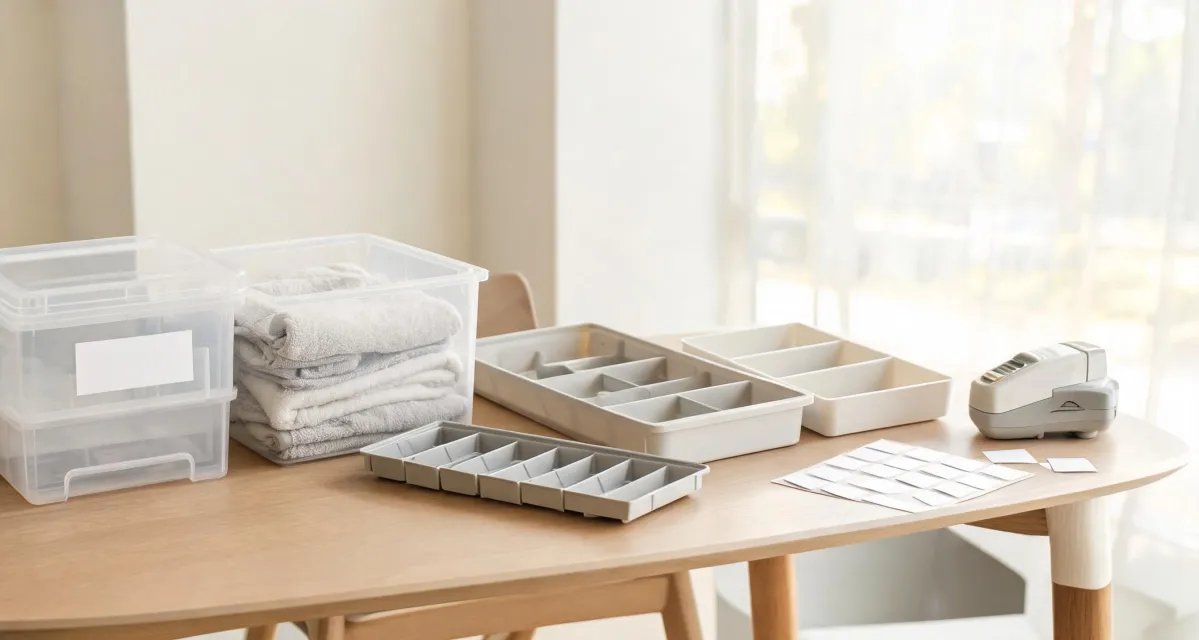
Most people shop for a storage bin the way they'd buy a cardboard box: check the quart size, glance at the price, and assume every clear plastic container works the same. That assumption is exactly why so many garage shelves end up with popped lids, dust-caked interiors, and stacks that wobble. The IRIS USA 16-quart WeatherPro box deserves a different kind of scrutiny. Its real advantage isn't capacity—it's that the lid stays shut under the weight of the box above it. That sounds like a small detail until you've watched a cheap bin's lid bulge open and let a season of dust ruin what you'd neatly packed. On a typical shelf, a 16-quart footprint is considered small, but it's precisely that size that lets you stand three high without the bottom unit bowing. Judge a bin by its latch and its stacking geometry, and the WeatherPro starts to look less like a small box and more like a smart one.
The Storage Bin Nobody Thinks About—Until It Fails
Capacity is the number on the label, but durability stays invisible until you put weight on it. A 16-quart box holds about four gallons—modest by any measure—yet on a garage shelf that depth is exactly what allows you to line up several units on one board and stack three high without the bottom box bowing or the lids popping. WeatherPro is built around that reality: the lid locks into place with a firm click, and the base is shaped so the next box sits inside the rim rather than balancing on top of it. That is the difference between a tidy wall of boxes and a leaning tower that sheds dust every time you bump it. When you are deciding between a discount bin and the IRIS USA WeatherPro, the question should not be 'how much fits inside'—it should be 'will this still be closed when I need it next spring?'
That kind of design intent does not come from a company that just started stamping out plastic. IRIS USA made its name as the first company to introduce clear plastic storage containers to the United States, and the brand's own history shows a long adjustment period: it began nearly three decades ago as a subsidiary of Japan's IRIS OHYAMA, struggled to gain traction, then got picked up by a major West Coast retailer within six months. That early bet on clear storage grew into dedicated manufacturing and distribution facilities in Wisconsin and Texas, followed by a U.S. headquarters in Surprise, Arizona, in 2016. What that history signals for the WeatherPro line is straightforward: this is a company that has spent decades solving the problems of stacking and of seeing what is inside without opening every lid. The latch and base geometry you get on the 16-quart box are not afterthoughts; they are the product's core, refined through years of getting storage right.
Why Shoppers Pick the Wrong Box—and How to Avoid It
Why do so many bins end up cracked, popped open, or abandoned in a corner? The failure almost never happens at the plastic walls—it happens at the lid and the base. A bin that sits on a shelf with a loose lid collects dust through the seam, and when you lift it, the lid lifts instead of staying sealed, spilling its contents across the garage floor. Stack a second bin on top of a flimsy base and you will feel the bottom box flex; in a few months, hairline cracks appear at the corners where the weight concentrates. The root cause is that most manufacturers design bins as open boxes with an afterthought lid, not as a vertical system. So the real test is not the volume number stamped on the side—it is whether the lid locks, whether the base accepts the next box, and whether the walls hold their shape under load. That test is what separates a storage investment from a disposables habit, and it is the reason a 16-quart box can outperform a 27-gallon one when the smaller box is the one that seals. Capacity without a working lid is just a dust collector that happens to be tall.
For the 16-quart size, that test plays out in a specific sweet spot. It is the right home for holiday ornaments, crafting supplies, children's toy sets, and the kind of small gear you want visible without unstacking everything to find one item. On a shelf that is 12 to 14 inches deep, a 16-quart box slides in and out cleanly, and three units stack to a height that does not crowd the next shelf. What it is not for is bulky seasonal gear: heavy coats, comforters, or power tools belong in the 18-gallon (72-quart) or 27-gallon (108-quart) totes in the same WeatherPro family. Buy the 16-quart for vertical density and small-item grouping; go bigger when the item itself is what you are storing. That distinction sounds obvious, but it is the first filter most shoppers skip—and the reason so many 'storage solutions' end up in a closet, empty and annoying, is that the wrong size gets chosen in the store aisle.
The company's own product architecture backs up that stacking promise. IRIS USA's site organizes a whole WeatherPro line under labels like 'Storage General' and 'WeatherPro Stack & Pull,' which is a design signal rather than marketing fluff: the WeatherPro family includes file boxes, storage containers, shoe storage, and the larger 18- and 27-gallon totes, and the Stack & Pull feature points to a system where handles and stacking points line up across sizes. That compatibility means a 16-quart WeatherPro does not have to end its life as a lonely box—it can sit beneath a WeatherPro file box or beside a larger tote in the same run, all clicking into the same footprint. When a manufacturer builds that kind of family consistency, the individual box benefits even if you only buy one.
WeatherPro vs. the Generic Bin: What Actually Changes
Put a generic bin next to the WeatherPro 16-quart and the first difference is the lid. On a typical unbranded bin, the lid is a flat sheet that sits on a lip; it keeps out nothing but the largest debris, and when you stack a second box on top, the lid bows slightly and creates a gap on one side. The WeatherPro lid, by contrast, drops into the base and latches on multiple points, so the seal holds even when you press down from above. That matters far more than the difference in wall thickness, because dust does not care about plastic thickness—it cares about seams. In a garage or closet, a sealed lid means the box you open in December is as clean as the day you packed it in January. And that is not a luxury feature; it is the core job of a storage container. If you have ever peeled open a cardboard box of ornaments that sagged in the damp or shaken dust out of a clear bin that looked sealed, you already know why the lid is the first thing to judge. A lid that seals also means less re-washing of stored items, and it stops bugs and moisture from turning a neat stack into a science experiment.
The second difference shows up the moment you build a stack. Generic bins are often designed with flat tops and flat bottoms, which means the upper box slides around on the lower one and the whole column twists with the first heavy item you place on top. WeatherPro boxes use a recessed footprint that nests the next unit, and the walls carry vertical ribs that stiffen the body along its height. That is why a 16-quart WeatherPro can sit under the same line's 18-gallon and 27-gallon totes—the brand's own catalog lists those larger sizes in the WeatherPro family, which tells you the stacking geometry is meant to work across the range. The practical result: you can go three high without the base box bowing, and you can pull the middle box out without the top two sliding off. That kind of stability is what turns a shelf of bins into a permanent system rather than a temporary pile.
A third area to consider is the company behind the plastic. IRIS USA has invested in U.S. manufacturing and distribution across four states—Wisconsin and Texas for the original facilities, Surprise, Arizona, as the U.S. headquarters opened in 2016, and a new center in Pennsylvania that came online in fall 2020. That footprint does not automatically make every box perfect, but it changes how you read the quality claims: a brand with that much capital in domestic production has a reason to keep the WeatherPro line consistent, because a reputation for cracked lids would follow it across every retail shelf it ships to. Cheap bins come from whoever wins the bid this quarter; WeatherPro comes from a company that is in the storage business for the long haul, across home goods, pet products, and small appliances. When the maker is that invested, the box you buy is more likely to be the box you keep.
The Decision Rule: Buy the 16-Quart If—and Only If—
Here is the rule that settles the 16-quart debate. Buy the IRIS USA 16-quart WeatherPro when you are storing lightweight, shelf-sized items that benefit from vertical stacking: holiday décor, craft and office supplies, kids' toys, wrapping paper, seasonal accessories. Skip it and go to the 18- or 27-gallon WeatherPro totes when the item is heavy, bulky, or too large for a shelf—comforters, power tools, camping gear, off-season clothing piles. Run this quick checklist before you buy. First, does the lid latch with a positive click on all four corners? Second, does a second box's base sit inside the first box's rim without wobble? Third, can your shelf depth fit the 16-quart footprint with room to slide? If you answer yes to all three and your items are small enough, the 16-quart WeatherPro is the right call. If any answer is no, the larger sizes make more sense. The checklist works because it forces you to think about the real conditions—dust, weight, and reach—rather than the number on the label. A bin that fits your shelf and seals is worth more than a bigger bin that never sits right.
Price makes that decision easier than you would think. IRIS USA sells directly from the manufacturer and frequently pairs the WeatherPro line with promotions like 15% off and free shipping, with the same offers running across its product catalog. That means a 16-quart box, or a set of them, lands at a price that undercuts the 'premium bin' aisle markup at big-box stores. It is not the cheapest clear box you can find, but the gap between the generic bin and this bin is smaller than most shoppers assume—and the durability difference has to be measured in years, not dollars. When the premium is that thin, choosing the better lid and stack geometry stops being an upgrade and becomes the obvious default.
Final Word: A Small Box That Outperforms Its Size
So is the 16-quart WeatherPro worth it? Yes—but only when it is matched to the right scenario. If you need to pack a garage wall with small, visible, dust-sensitive items, this box does what the bigger totes cannot: it uses shelf height without wasting depth, and it keeps the contents clean because the lid actually stays shut. If you try to use it for bulky gear, it will feel undersized, and that frustration has nothing to do with the product—it is a mismatch of tool and task. The verdict that holds across all this: judge storage boxes by fit, not by the number on the label. A 16-quart bin that seals and stacks is worth more than a 27-gallon bin that does not. The WeatherPro earns that judgment by passing the two simplest tests a storage box can face: the lid clicks, and the stack stands. Buy it for the fit, and the capacity will take care of itself.
Before you buy any storage container, run the two-second test. Press the lid down hard, then stack two units on top of each other. If the lid clicks and holds and the stack stands firm, it is a keeper; if the lid pops or the column wobbles, walk away regardless of the brand or the price tag. That rule applies beyond the WeatherPro line—it will save you money on every bin, tote, and organizer you ever shop for. Some shoppers will tell you to buy the largest box you can afford; they are usually the ones with a stack of broken lids in their garage. The 16-quart WeatherPro passes the test because its lid and base are designed for stacking, not just for holding. And that, not the quart number, is the reason it earns a place on your shelf.
Latch first, stack second, shelf third. The 16-quart WeatherPro clears all three tests, and that is the whole argument.

Leave a Reply