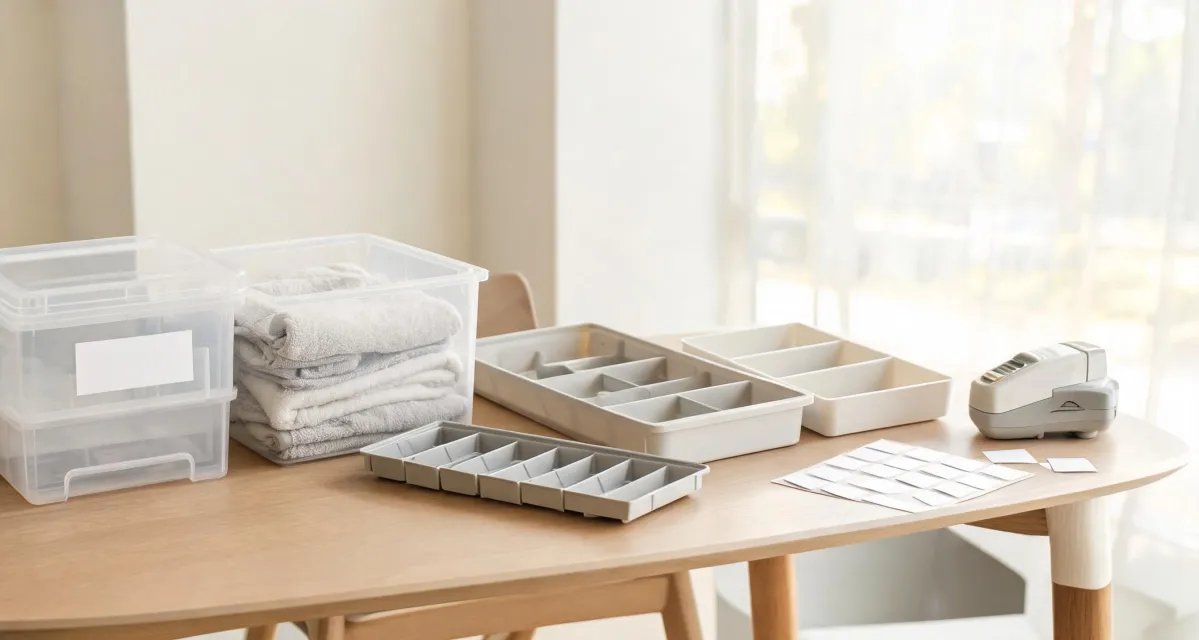
Most shoppers treat a plastic storage box as a throwaway: grab the cheapest tote, shove it on a shelf, and pray the lid stays on. That instinct leaves garages with cracked corners and leaning towers. The IRIS USA 16 Quart WeatherPro Plastic Storage Box is a worthwhile upgrade over generic bins, not because it is bigger, but because it comes from a company with nearly three decades of clear-storage experience and a design built around how stacks actually behave.
The Storage Problem Nobody Talks About
The problem nobody talks about is not whether a box holds twenty pairs of shoes. It is whether that box can hold up under the weight of three boxes stacked on top of it, whether the lid seals when you set it down hard, and whether the plastic stays rigid in a hot garage. Cheap bins fail on all three counts. Their walls flex, the lid pops off at the first bump, and the stack leans like a Jenga tower. So when you compare storage boxes, you are really comparing two different promises. One promise is 'this will hold stuff until you move it.' The other is 'this will hold stuff for years, through reorganizing, stacking, and the occasional drop.' The IRIS USA 16-quart WeatherPro belongs to the second category. The price difference between it and a generic tote is small, but the difference in behavior is not. That is a distinction worth paying for, and it is the reason this review focuses on how the box earns its premium.
IRIS USA did not stumble into this product category. Nearly three decades ago, the company became the first to introduce clear plastic storage containers to the United States. It was a slow start, and the brand struggled to gain traction at first. But within six months, a major West Coast retailer adopted the line, and other chains quickly followed. That adoption was not luck. Retailers do not clear shelf space for a storage box that arrives cracked or stacks unevenly. The fact that IRIS USA converted its first big account in half a year tells you the product performed on the floor, not just in a brochure. And the company kept betting on that performance: it built manufacturing and distribution facilities in Wisconsin and Texas to support the growing plastic storage lines, and later expanded further. For a buyer, this history is a signal. A company that pioneered a category and then invested in U.S. plants is not a fly-by-night operation. When you buy its 16-quart box, you are buying a product from a maker that has a long track record to protect.
Why Brand History Matters in a Plastic Box
Brand history matters because manufacturing experience cannot be faked in a mold. IRIS USA has been investing in domestic production for a long time. The company opened manufacturing and distribution facilities in Wisconsin and Texas to keep up with demand. In 2016, it added a new facility in Surprise, Arizona, which now serves as U.S. headquarters. In the fall of 2020, it opened its latest manufacturing and distribution center in Pennsylvania. That trajectory matters when you are buying a 16-quart box. Every one of those plants represents a decision to control quality, logistics, and supply. A company that outsources everything can cut corners on wall thickness or latch tolerance without anyone noticing until the product is in your garage. IRIS USA's visible investment in U.S. facilities makes that kind of corner-cutting far less likely. That is the kind of commitment a plastic box cannot communicate by looking at it.
Here is how those years of manufacturing show up in a single box. When a mold is refined over decades, the plastic flows evenly, so walls have consistent thickness instead of thin spots. The lid snaps on with a clear click because tolerances are tight, not because you forced it. The stacking rim aligns with the box below because the tooling was built to pair WeatherPro boxes with each other. You notice these details the third time you move the stack, when the box does not bow under a heavy load, and when the lid stays sealed after a summer of temperature swings. A company that has spent nearly three decades in this category has had time to learn every place a cheap tote fails. It has repaired, retested, and redesigned, so the quality is built into the geometry, not just the material. The result is a box whose behavior you can rely on, even if the plastic looks ordinary from the outside.
Consider the six-month story as an example of what this brand does under pressure. IRIS USA's U.S. launch was slow, but within six months a major West Coast retailer adopted the clear plastic storage line. That is fast for a new product from a Japanese subsidiary. It says the retailer tested the boxes, checked how they nested, and saw a product that would not embarrass the store. When a big retailer bets on you that fast, it usually means the product passed a much harder test than any advertising slogan. That same attention to getting it right is still in the company's DNA. The 16-quart WeatherPro box is made by the same organization that won over a skeptical retailer decades ago, which is exactly the kind of behavior you want behind a product you will stack in your garage.
The WeatherPro Line: Built for Stacking and Pulling
The WeatherPro line is not just a collection of totes with a name slapped on. It is designed as a system, and the signature is Stack & Pull. The website places WeatherPro Stack & Pull front and center alongside file boxes, shoe storage, laundry bins, and under-bed containers. The core idea is simple: boxes that lock together securely when stacked but release with a purposeful pull when you need the bottom one. That behavior matters far more than the 16-quart volume. Most storage accidents happen when you try to pull out a heavy bottom box and the whole tower shifts. WeatherPro's Stack & Pull gives the boxes interlocking edges, so you tug the box you want without destabilizing the stack. That is a real design advantage, not a marketing phrase. It is the difference between a shelf of boxes and a storage system.
When a product family appears everywhere in a lineup, it tells you the company treats it as a core commitment. On the IRIS USA site, WeatherPro appears in the navigation, in sale banners, and across storage categories, often with a 15% discount and free shipping. That prominence means the company is putting its marketing weight behind the line. For you, that is useful before you compare prices. A line that gets premium placement is a line the manufacturer is confident about, because a major miss would hurt the whole brand. So when you look at a generic bin next to a WeatherPro box, you are not comparing two equal unknowns. You are comparing a product a company chose to lead its storage assortment with a product that might be a private-label afterthought. The placement itself is a signal worth factoring into the price. That is a benefit you can check before paying.
The WeatherPro family also shows up in sizes that make the whole system practical. The IRIS USA catalog pairs the small organizers with 18 Gallon Totes (72 qt.) and 27 Gallon Totes (108 qt.), plus drawer units and specialty boxes. That breadth matters when you are planning a room. You can start with a single 16-quart box for one shelf and later add larger WeatherPro containers that interlock with it. The 16-quart box is not a dead-end size; it is part of a family. When a brand offers a range like this, it usually means the molds and designs are shared across the line. So a feature you like in the 16-quart box, like the Stack & Pull rim, is likely to work in the 18- and 27-gallon versions. That makes the purchase less risky. You are not investing in one incompatible bin; you are investing in a system you can expand.
Comparing Your Options: WeatherPro vs. Generic Bins
So how should you actually compare a WeatherPro box with a generic bin? Start with the lid. Does it snap with a positive click, or does it just rest on top? Second, check the stacking geometry. Put the box on a hard floor and press down; does the rim deflect? Third, look at the taper. A drastic taper lets boxes nest for shipping but wastes vertical space when stored. Fourth, consider the warranty and brand support. Will the manufacturer answer if a batch has a defect? Finally, think about how the box behaves after a year of temperature change. Plastic that is too thin can warp in the sun. These criteria turn an abstract 'quality' debate into a concrete checklist. Use them the next time you walk down the storage aisle. You will quickly see why a generic bin can look like a bargain in the photo and a bad deal six months later.
Run a generic bin through that checklist and the differences become visible. The IRIS USA website itself is built around direct-from-manufacturer selling, with the Promise of 'Best Price from Manufacture' and free shipping. That model shortens the chain between the factory and your garage, which is why the company can run promotions like 15% off on WeatherPro without making you wonder if it is a knockoff. The product catalog, meanwhile, puts WeatherPro at the top of the storage categories, right next to Stack & Pull and the large 18- and 27-gallon totes. That is not an accident. The brand is telling you this is the line it wants to sell, and it is backing the claim with its own retail channels. When you buy a WeatherPro box, the packaging support and the product documentation come from the same company that built the product. With a generic bin, you often cannot even find a phone number for the manufacturer. That asymmetry is part of the value.
Now put the generic bin on the other side of the scale. It is cheaper, and it might do the job if all you need is to slide a few boxes under a bed and never move them again. But the generic option usually forces you to mix and match sizes that do not align. A 16-quart tote from one brand may not stack cleanly on a 27-gallon tote from another, and the lids might not stay on when you carry them. WeatherPro removes that guesswork because the line is designed to fit together, from the 16-quart box up to the 18 Gallon Tote (72 qt.) and 27 Gallon Tote (108 qt.). You can build an entire room around one system. With generic bins, you are assembling a pile of unrelated containers that may fight each other in the garage. The extra money buys you that coherence.
Verdict: When the IRIS USA 16-Quart WeatherPro Is the Right Pick
The verdict is straightforward: buy the IRIS USA 16 Quart WeatherPro Plastic Storage Box when you are building a stack that will stay put for years. The company's direct-from-manufacturer model, with the 'Best Price from Manufacture' promise and free shipping, removes the usual excuse that a branded product is only for people who overpay. When WeatherPro goes on sale at 15% off, the price gap between it and a generic bin narrows even further, and the design advantages stay. You are paying for a box whose stacking geometry is intentional, whose lid is attached to a brand that has been in the clear-storage business for nearly three decades, and whose manufacturer will answer if something goes wrong. That is a clear-eyed purchase, not a premium for a logo. The box earns its place in your garage because it does the one thing a storage box is supposed to do: keep your stuff accessible without turning your life into a balancing act.
The boundary condition matters. Do not buy the 16-quart WeatherPro if you only need one temporary bin for a move. In that case the generic tote is the rational purchase, because the design advantages of Stack & Pull never get used. Also skip it if your storage plan never involves stacking; a single box on a shelf does not need interlocking edges. But if you are outfitting a closet or garage wall with multiple containers, the 16-quart box makes sense because it connects to the larger WeatherPro family. The catalog's 18 Gallon Tote (72 qt.) and 27 Gallon Tote (108 qt.) are designed to work with the same system, so you can start with a couple of 16-quart boxes and expand without creating a shelf of mismatched containers. The verdict is not 'replace every bin you own'; it is: when stacking and durability matter, the WeatherPro is the right pick, and when you just need a disposable tote, save the money.
The IRIS USA 16 Quart WeatherPro Plastic Storage Box earns its place by behaving differently when it counts—not by being the cheapest, but by being the most reliable box in the stack. That is the verdict, and it is one you can check every time you pull one box off the pile without the tower shifting.

Leave a Reply