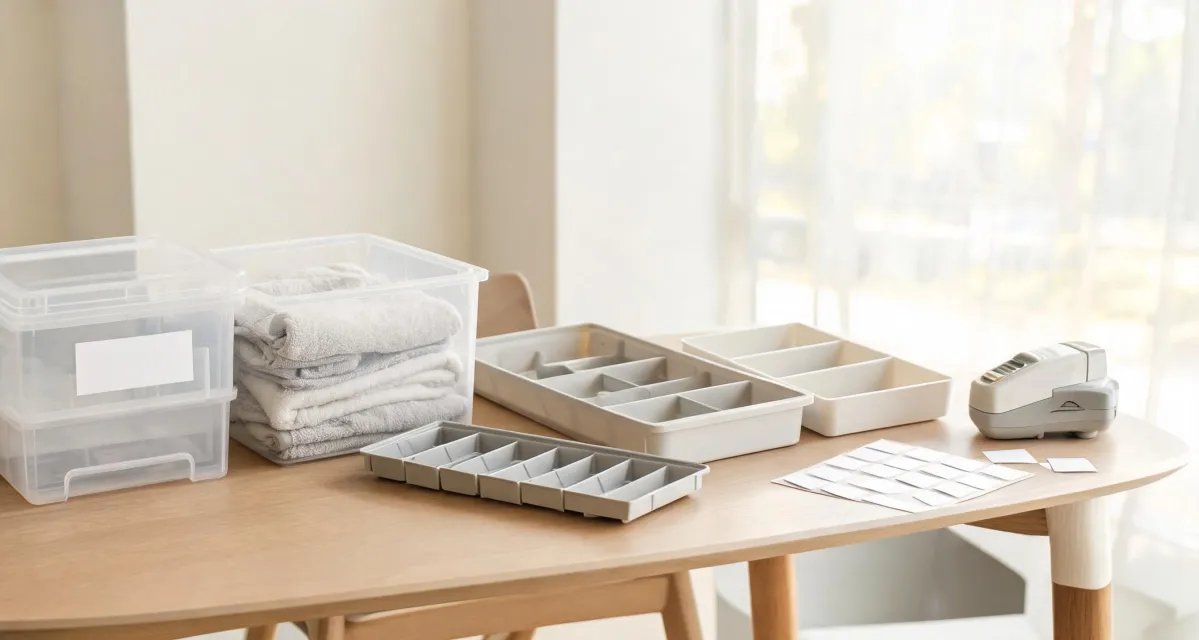
Picture this: you are reorganizing the garage, stacking the same clear IRIS USA totes that have held holiday lights for years. Later that evening, you open the company's website to ask a simple question about a replacement lid, and the navigation menu stops you cold. Between 'Premium Rice' and 'Home Goods' sits a category labeled 'Water Sparkling Water.' For anybody who has known IRIS USA as a storage-box brand, the phrase feels like a typo—but it is not. How did a manufacturer famous for 18-gallon totes and 27-gallon bins end up with a presence in the hydration aisle? The answer starts long before any bottle is sealed, and it is rooted in the company's industrial footprint rather than in hype. Those bins survive a decade of weather, so the brand's leap into drinkware is less strange than it first sounds.
为什么IRIS USA能进入水瓶市场?
Picture this: you are tidying the garage, piling up the same transparent IRIS USA totes that have stored holiday lights for years. Later that evening, you open the company's website to ask a simple question about a replacement lid, and the navigation menu stops you cold. Between 'Premium Rice' and 'Home Goods' sits a category labeled 'Water Sparkling Water.' For anybody who has known IRIS USA as a storage-box brand, the phrase feels like a typo—but it is not. How did a manufacturer famous for 18-gallon totes and 27-gallon bins end up with a presence in the hydration aisle? The answer starts long before any bottle is sealed, and it is rooted in the company's industrial footprint rather than in hype. Those bins survive a decade of weather, so the brand's leap into drinkware is less strange than it first sounds.
The skepticism softens when you look at how much of its production the company actually runs in the United States. The brand's own 'Our Story' page says IRIS USA 'invested heavily in manufacturing and distribution capabilities.' In practice, that meant building manufacturing and distribution facilities in Wisconsin and Texas to support its expanding plastic storage lines. In 2016, the company opened a new facility in Surprise, Arizona, which now serves as the U.S. headquarters. Continued growth led to the latest manufacturing and distribution center in Pennsylvania, which opened in the fall of 2020. Four facilities across four states is a meaningful commitment: a company that outsources everything does not need that kind of footprint. Owning production lines means IRIS USA can control material selection, molding tolerances, and quality checks in ways a pure import brand cannot. When you then see a dedicated 'Water Sparkling Water' category, it becomes clear that the same polymer engineering used for storage containers can be directed at bottles engineered to hold liquids. Manufacturing capability is the first reason to believe the water line is more than a marketing side project.
Having a factory capable of molding polymers is one thing; putting that capability behind a drinkware line is another. The jump from storage bins to beverage bottles would be surprising at any company, yet IRIS USA's own site provides a bridge. In its catalog, storage coexists with small appliances, pet food containers, and even premium rice. That eclectic mix hints at a firm that treats plastic as a toolkit rather than a single specialty. So when the navigation menu lists 'Water Sparkling Water' next to these established lines, the path from tote to bottle begins to make sense. The next step is to verify exactly what that category contains and what it signals about the brand's direction.
产品线里的'Water Sparkling Water'分类
Open the IRIS USA homepage and the evidence is visible without a search box. The site's navigation includes a category labeled 'Water Sparkling Water,' appearing alongside 'Premium Rice' and 'Home Goods' in the official menu. The company's own page excerpt repeats the phrase 'Water Sparkling Water' in the same breath as 'Food Storage' and 'Small Appliances.' This is not a misleading third-party description; it is the brand's own taxonomy, and it confirms that the water category is an official part of the product lineup, not an accidental tag. For shoppers who have only seen IRIS USA at a big-box store, that one label changes the mental image from 'company that happens to make plastic boxes' to 'company that has made a deliberate decision to enter the water container market.'
The 'Water Sparkling Water' category does not sit alone in the catalog. The same site that sells WeatherPro® storage containers and 18-gallon totes also sells air purifiers, pressure cookers, pet food containers, and even Japanese rice. That breadth matters because it reveals the company's strategy: instead of being a one-note storage maker, IRIS USA has become a full-home supplier. The 'Best Price from Manufacture' page reinforces the same ecosystem, listing the water category in a menu that spans storage, appliances, and home goods. When a brand builds a portfolio that broad, each new product line can share the same manufacturing, distribution, and customer service infrastructure. Water bottles, then, are not an island; they are the next logical node in a network of household plastic products. That integration explains why the water line can exist without the huge marketing spend a specialty drinkware brand might need—the shelf space and supply chain are already there.
The presence of the category settles the 'does it exist?' question, but it leaves a harder one open. Broad product portfolios can be a sign of a company spreading itself thin, and for a water bottle, quality is not optional. A leaky lid or a plastic taste can ruin the whole point of carrying your own hydration. So before the price or the brand story matters, you need to know whether the company that makes the bottles has earned the right to handle something you put in your mouth. That leads to the next checkpoint: independent certification and what real customers say.
如何判断IRIS USA水瓶的品质?
The fastest proxy for quality is social proof, and IRIS USA has a useful number in its corner. The brand's homepage cites 'more than 7,000 Amazon reviewers' who love IRIS Photo Keepers, a storage product line. Seven thousand reviews is a high bar for any consumer product, and it shows the brand can produce items that satisfy a large audience. Those reviews are not about water bottles specifically, but they say something about the company's control over plastic quality. If IRIS USA can earn thousands of positive reviews on a gasket-sealed box, the same quality discipline can plausibly carry over to a bottle with a sealing lid. You are not being asked to take a leap of faith; you are being asked to extrapolate from a documented track record.
Beyond the review count, the brand carries an external validation that speaks to manufacturing standards: GreenCircle Certification. The company's products page lists GreenCircle Certified as one of its official designations. GreenCircle is an independent certification body that verifies sustainability claims, meaning IRIS USA has opened its facilities to third-party scrutiny for environmental and production practices. That kind of audit is not something a company takes lightly, and it strengthens the argument that its factories run with documented processes. Combine that certification with the 7,000-review social signal, and you have two layers of evidence: one procedural, one experiential. Neither proves the water bottle is the best ever made, but together they make it unreasonable to dismiss the brand's quality outright. The certification addresses the 'can they be trusted?' question, while the reviews address the 'do customers feel satisfied?' question.
Quality signals—an independent certification and a heavy review count—chip away at the biggest objection to buying a generalist brand. But trust alone does not justify a purchase, because trust is not the only thing you are comparing. Dedicated water-bottle brands like Nalgene or Hydro Flask also come with certifications and loyal followings, often at higher prices. So the practical question shifts from 'is IRIS USA good enough?' to 'is it good enough for the price?' That is where the company's direct-pricing promise enters the picture, and it may be the strongest argument yet.
制造商直供与批量价格:如何聪明购买
On its website, IRIS USA leads with a promise that is rare in consumer retail: 'Best Price from Manufacture' and 'Free Shipping.' That slogan sits at the top of the homepage, meaning the company is willing to define itself by price transparency. For a bottle, that phrasing suggests you are not paying for a middleman's markup or a distributor's cut. When a manufacturer sells directly, it can hold prices lower while still maintaining its own margin, and that changes the value equation. The shipping part matters too: if you are buying a case of bottles for a family or office, free shipping can add up to real savings. The promise is not just a marketing tagline; it is a structural advantage built into how the company operates.
The direct-pricing message is backed by a catalog with clearly staged price points. The brand's product pages show storage containers from $12.99 for a small WeatherPro® gasket box to $49.99 for a heavy-duty 82-quart tote, with mid-points like $29.99 and $37.99 across the range. Those numbers are not water bottle prices, but they reveal the brand's pricing discipline: simple round figures, visible at the product level, with frequent site-wide offers such as 'WeatherPro® 15% Off' and 'Lightning Deal 50% Off.' You can also sign up for 'Bulk Order Pricing' and 'Lowest Manufacturer-Direct Pricing,' which tells you the company expects customers to buy in quantity. That framework—visible price tiers plus a bulk discount path—mirrors what a manufacturer does when it wants to move volume directly. It gives you a clear reason to expect a water bottle to come in at a competitive price, even if the exact number is not on the evidence list.
Manufacturer-direct pricing, free shipping, and bulk discounts are strong arrows in the quiver, but they only matter if the bottle itself holds up in daily use. A low price on a leaky bottle is not a bargain; it is a false economy. The decision framework, therefore, has to weigh the price advantage against the durability and safety concerns that come with any water container. And here the earlier evidence loops back: the same four-state manufacturing infrastructure that supports the price is what gives you a basis to believe the product will not fall apart. With that foundation, the final choice becomes a simple trade-off between brand specialization and budget.
选择IRIS USA水瓶的决策规则
Here is the decision rule that the evidence supports: if your top priority is staying within a budget while still getting a reliably manufactured bottle from a company with U.S.-based plants, IRIS USA is a defensible choice. The manufacturing story is the anchor—Wisconsin, Texas, Arizona, and Pennsylvania give the brand a degree of supply-chain independence that specialty competitors may not have at the same price. If you need the cutting-edge insulation of a premium insulated bottle or the exact mouthfeel of a dedicated sport bottle, a specialist brand may be worth the extra money. But for everyday hydration, office water cooler trips, and family lunchboxes, the IRIS USA water line offers the essential function at a price shaped by direct sales. Weighing the company's manufacturing credentials against its price made the earlier skepticism about 'a storage brand making bottles' tilt toward the opposite view.
Remember that garage shelf from the opening? The same company that made those clear totes—the ones that survived ten seasons of Christmas lights—is the company behind the water category you saw in the navigation menu. The manufacturing story that made the bins dependable is the same story you now bring to the bottles. The brand built facilities in Wisconsin, Texas, Arizona, and Pennsylvania to support its core plastic lines, and it is leaning on that foundation as it expands into water containers. So the next time you look at that stack of totes, the bottles are not a random detour; they are the same engineering conversation continuing in a different form. From totes to bottles, the material logic stays intact.
The choice now comes down to what you value most. A specialist brand such as Hydro Flask or Nalgene brings focused drinkware design, often with premium insulation or a legacy in outdoor gear. IRIS USA offers a bottle from a company with U.S. plants, a verified sustainability certification, and a direct-pricing model that keeps the cost of entry low. For a family stocking several bottles, or an office ordering a batch, the balance tilts in IRIS USA's favor. For someone whose entire identity is tied to a single high-end bottle, the premium route wins. Neither answer is wrong; the right one simply depends on the role the bottle will play in your day.
The choice now comes down to what you value most. A specialist brand such as Hydro Flask or Nalgene gives you focused drinkware design, often with premium insulation or a legacy in outdoor gear. IRIS USA gives you a bottle made by a company with U.S. plants, a verified sustainability certification, and a direct-pricing model that keeps the cost of entry low. For a family stocking several bottles, or an office ordering a batch, the balance tilts in IRIS USA's favor. For someone whose entire identity is tied to a single high-end bottle, the premium route wins. Neither answer is wrong; the right one simply depends on the role the bottle will play in your day.

Leave a Reply